
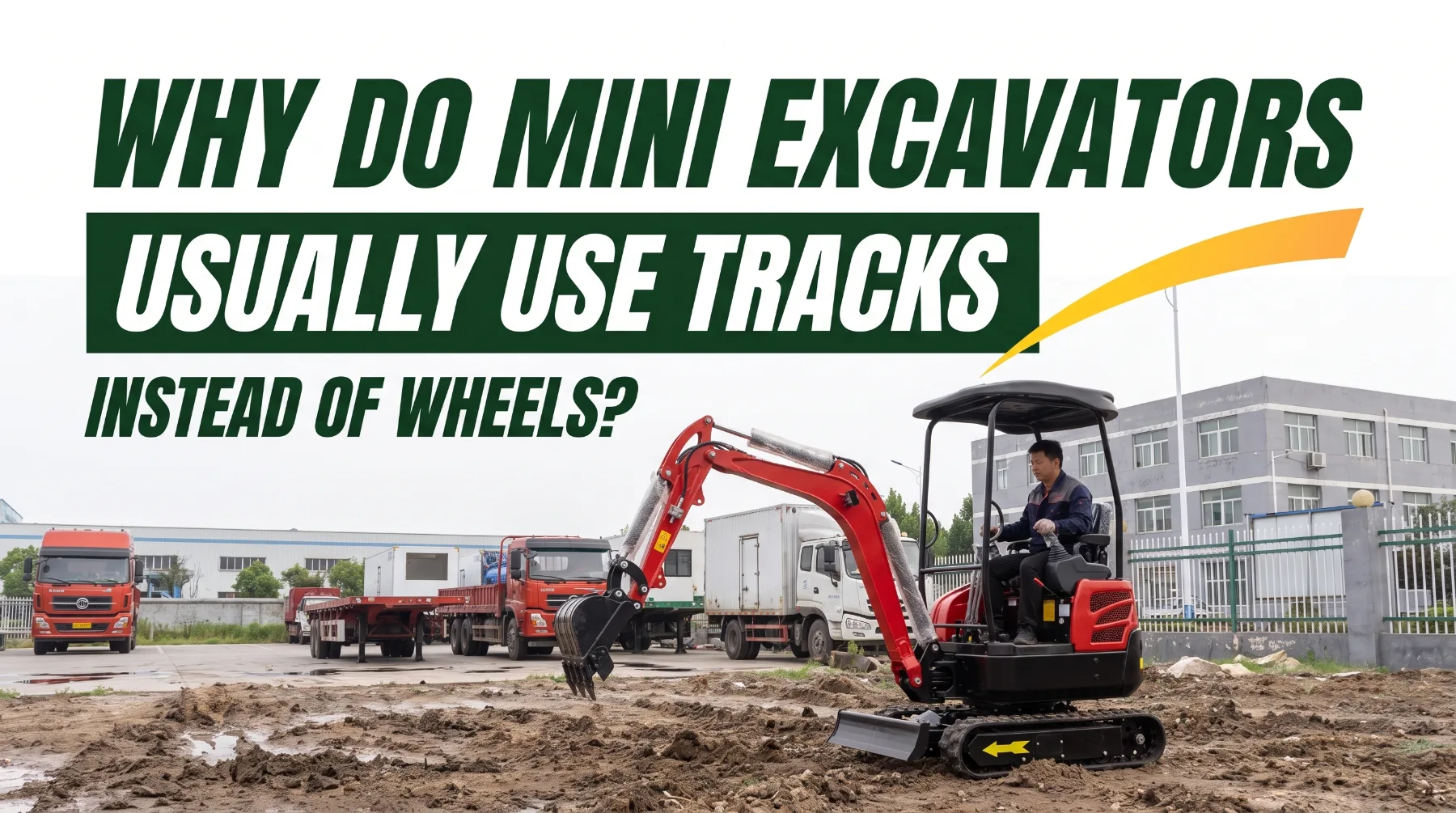
Why Do Mini Excavators Usually Use Tracks Instead of Wheels?
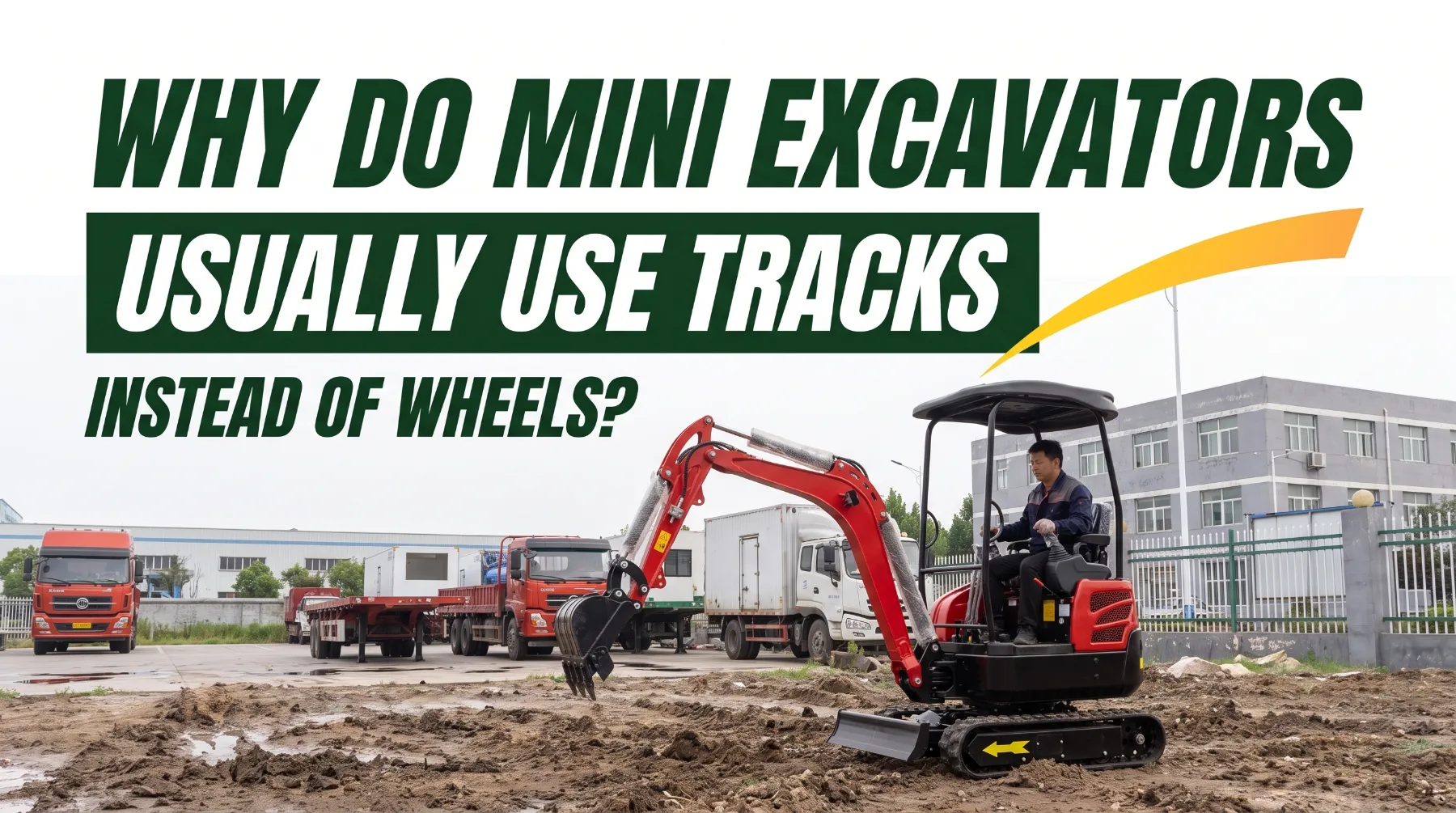
Walk onto almost any mini excavator job site and you will notice the same design choice: tracks are far more common than wheels. That is not simply a matter of tradition. Tracks give a compact excavator the stability, traction, and low ground pressure needed for digging, lifting, and working on uneven or soft ground. Their larger contact area spreads the machine’s weight over the surface, helping reduce ground pressure while keeping the excavator planted when the boom is working against resistance. Wheels can offer higher travel speeds and better road mobility, but they are generally less suited to the low-speed, high-stability demands of excavation.
The advantage of tracks becomes even clearer in confined or difficult working areas. They provide better grip on loose and uneven terrain, help distribute the machine’s weight, and can reduce surface damage when working on finished ground, depending on the track material. Their ability to pivot and maneuver within tight spaces also suits the compact footprint of a mini excavator. However, wheeled excavators still make sense for jobs that involve frequent road travel, firm surfaces, and longer distances between work areas. The right choice ultimately depends on whether your priority is off-road stability and traction or mobility between locations.
How Tracks Lower Ground Pressure and Keep the Machine Steady
Everything about a mini excavator’s footing starts with how its weight meets the ground. A tracked machine spreads its operating weight across two long, continuous rubber tracks rather than four smaller tire contact patches. This larger footprint produces low ground pressure, meaning less weight is concentrated on each square inch of ground. That low ground pressure helps a mini excavator stay mobile on soft or loose terrain where a wheeled machine may struggle or bog down.
Stability follows directly from that wide footing. When a machine digs, swings a loaded bucket, or lifts at reach, its center of gravity shifts, and a broad, planted base keeps that shifting weight safely inside the machine’s footprint. Tracks give the excavator a long, low, stable platform, so the operator can dig hard and lift confidently without the machine feeling tippy or nervous under load.
Wheels concentrate the same weight onto far smaller contact points, raising ground pressure and shrinking the base of support. On firm pavement that’s fine, but on the mixed and often soft ground a mini excavator lives on, that concentrated weight sinks in and undercuts the steady footing precise digging demands.
Key takeaway: tracks lower ground pressure and widen the base of support, giving the machine the steady, planted footing that safe digging and lifting depend on.
Traction That Holds on Soft, Muddy, and Uneven Ground
Grip is the next problem tracks solve, and they solve it decisively. The lugs molded across a rubber track bite into soil, mud, gravel, and loose fill, generating traction across the whole length of the belt rather than at four isolated points. That biting contact is what lets a mini excavator climb, push, and reposition itself on ground that offers a wheel almost nothing to hold.
Muddy and wet conditions expose the gap most clearly. A wheel spins and digs itself in when the surface turns slick, while a track’s long, aggressive contact keeps pulling the machine forward through the same muck. Uneven terrain tells a similar story: tracks conform to bumps, ruts, and slopes, keeping more of the drive surface in contact with the ground so the machine tracks straight instead of slipping off its line.
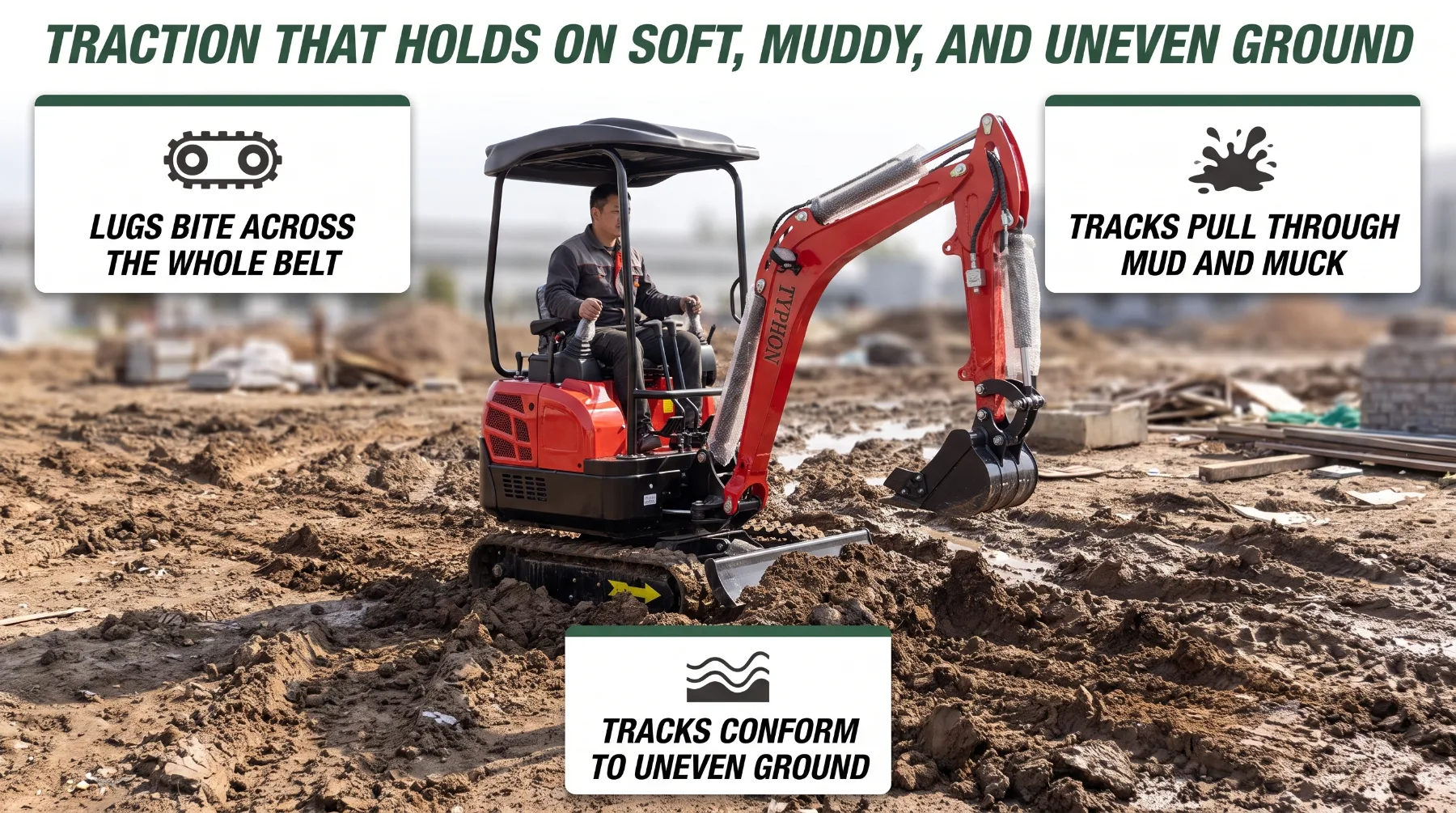
This traction matters because a mini excavator rarely works on a clean, level pad. It trenches in wet yards, crosses raw fill, climbs onto spoil piles, and grades on grade. Reliable grip in exactly those conditions is precisely what the work requires, and it’s where tracks earn their keep every shift.
Key takeaway: the long, lugged contact of tracks delivers dependable traction on the soft, muddy, and uneven ground where wheels lose their footing.
Protecting Finished Surfaces With Low Ground Disturbance
Consider the flip side of all that grip: because tracks spread weight so evenly, they also tread lightly. The same low ground pressure that stops a machine from sinking also means it disturbs the surface far less than a heavy, narrow wheel would. Rubber tracks, in particular, are designed to move a machine across sensitive ground without tearing it up.
That gentleness opens doors on jobs where the surface itself has value. Landscapers can cross established lawns, contractors can work on finished driveways and paved areas, and crews can operate near sod, hardscape, and irrigation without leaving deep ruts or gouges behind. Rubber tracks flex over the surface and distribute the load, so the machine does its work and leaves the ground close to how it found it.
A wheeled machine, carrying its weight on smaller, harder contact points, is far more likely to rut soft turf, crack delicate paving, or churn a manicured surface into a mess. For the residential, landscaping, and finish-grade work mini excavators so often handle, that difference decides whether the job leaves a clean result or an expensive repair.
Key takeaway: rubber tracks minimize ground disturbance, letting a mini excavator work over lawns, paving, and finished surfaces without the rutting and damage wheels tend to cause.
Working in Tight Spaces With Zero-Tail-Swing Design
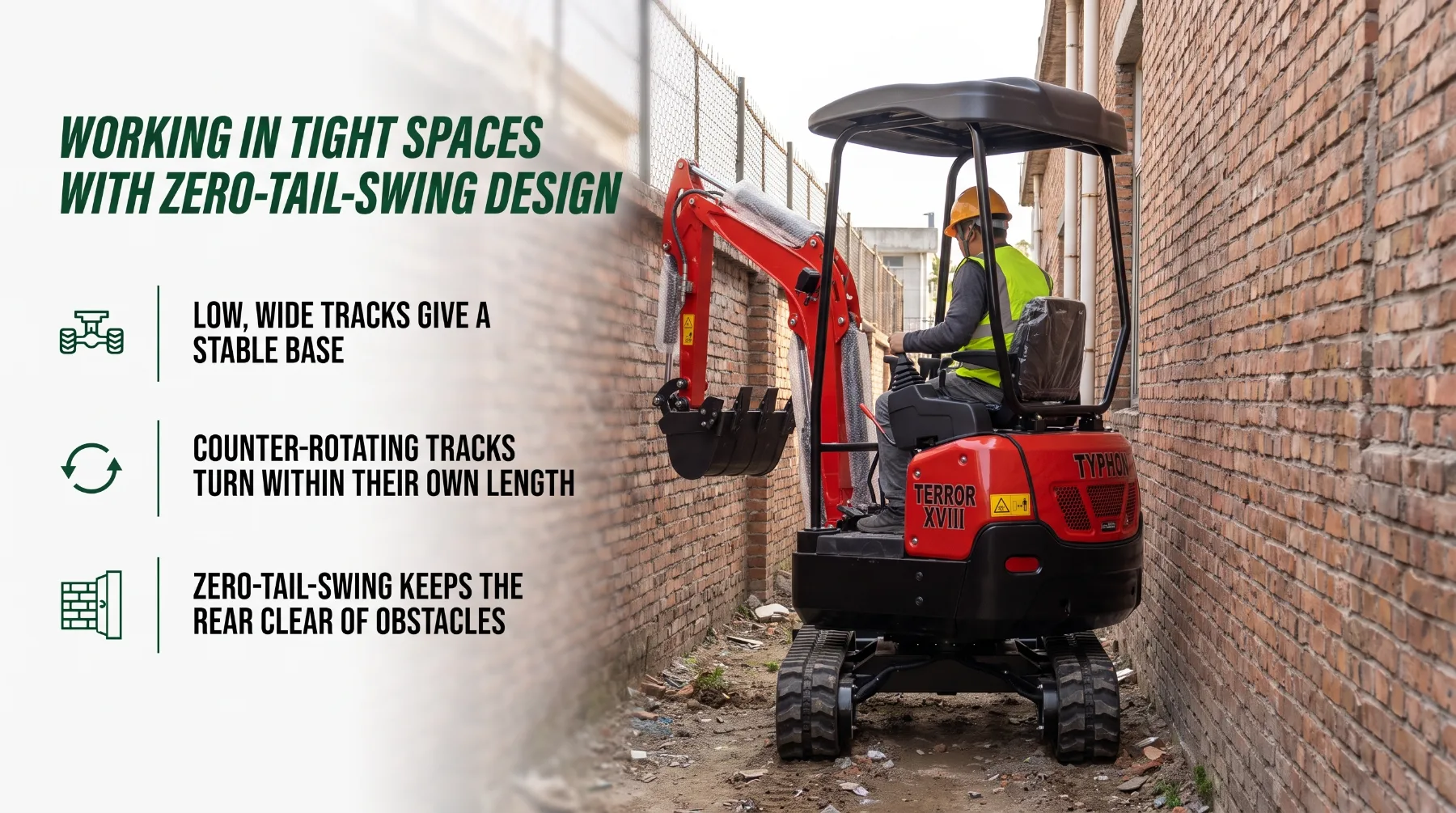
Compact size is the whole point of a mini excavator, and tracks are central to how these machines thrive in cramped quarters. A tracked undercarriage sits low and wide relative to the machine’s height, giving a stable base that lets the operator rotate, dig, and reposition confidently in spaces a larger machine could never enter. Backyards, between buildings, indoor demolition, and narrow trenches are all natural territory.
Maneuverability comes from how tracks steer. A mini excavator turns by driving its two tracks at different speeds or in opposite directions, letting it counter-rotate almost within its own length. That tight turning is a genuine advantage in confined work areas, where a wheeled machine needing room to steer and swing would be stuck.
Many mini excavators pair that agility with a zero-tail-swing or reduced-tail-swing design, where the rear of the machine stays within the width of the tracks as it rotates. The stable tracked base makes this design practical, letting the operator swing the upper structure hard against a wall or fence without the counterweight clipping anything behind it. Working tight to a boundary becomes routine rather than risky.
Key takeaway: the low, stable tracked base enables tight counter-rotation and zero-tail-swing operation, making mini excavators ideal for confined and boundary-hugging work.
Spreading the Machine’s Weight for Balance and Flotation
Weight distribution ties these advantages together by spreading the excavator’s mass across a long, broad track footprint rather than concentrating it at a few contact points. This creates better flotation, helping the machine stay on top of soft or loose ground instead of sinking into the surface.
Balance improves for the same reason. Spreading weight evenly across the undercarriage keeps the machine level and predictable, even as the boom extends and the load moves out and up. That even distribution is why a mini excavator can reach out with a full bucket and hold steady, rather than tipping toward the load or settling unevenly into the surface beneath it.
Think of it as the difference between standing on a plank across mud versus a pair of stilts. The plank spreads your weight and keeps you up; the stilts drive straight down and sink. Tracks are the plank, and that broad, even support is what keeps a mini excavator stable, floating, and balanced across the demanding ground it works on.
Key takeaway: running the full undercarriage length, tracks spread the machine’s weight for flotation on soft ground and steady balance under load.
When a Wheeled Excavator Makes More Sense
Tracks aren’t the answer to every job, and it’s worth being straight about that. Wheeled excavators hold real advantages in specific settings, chiefly where speed and hard, prepared surfaces come into play. A wheeled machine travels far faster than a tracked one and can often drive on public roads under its own power, moving between nearby sites without a trailer.
Urban and paved work is where wheels shine. On city streets, established roads, and hard industrial surfaces, wheels roll efficiently and don’t chew up the pavement the way steel components might, while the higher travel speed keeps a machine productive across spread-out job sites. For utility work along roadways or tasks that demand frequent repositioning over long distances on firm ground, a wheeled excavator can be the smarter tool.
The trade-off is that wheels cannot provide the same low ground pressure, soft-ground traction, and gentle surface contact as tracks. This is why wheeled excavators are more common in larger size classes and specialized applications, while mini excavators are predominantly tracked. The best setup ultimately depends on the ground conditions and the work the machine needs to perform.
Key takeaway: wheeled excavators win on speed and hard-surface travel, but the soft-ground, tight-space demands of mini excavator work keep tracks the standard choice.
Conclusion
The near-universal use of tracks on mini excavators comes from how closely their design matches the conditions these machines typically face. Mini excavators often work on soft, wet, uneven, or delicate ground and in confined spaces where stability and maneuverability are critical, while digging and lifting can shift the machine’s balance. Tracks provide low ground pressure to reduce sinking, a long contact area for better weight distribution and traction, and rubber surfaces that are gentler on lawns, paving, and finished ground. Their stable footprint also supports tight maneuvering and helps the machine remain planted when working on slopes or uneven terrain. Wheeled excavators can still be the better choice for jobs that require faster travel and frequent operation on hard paved surfaces, so the best option depends on the ground conditions, workspace, travel requirements, and type of work the machine will actually perform.
Frequently Asked Questions
Why don’t mini excavators use wheels like some larger excavators do?
Mini excavators are built for the kind of work where tracks clearly outperform wheels: digging on soft, wet, or uneven ground, working in tight spaces, and operating over surfaces that can’t be damaged. Tracks lower ground pressure so the machine stays on top of soft soil, deliver traction where wheels would spin, and spread weight for stability under load. Larger wheeled excavators exist for high-speed travel and hard, paved surfaces, but those conditions are the exception for a compact digging machine, so the mini class stays overwhelmingly on tracks.
Are rubber tracks better than steel tracks on a mini excavator?
For most mini excavator work, yes. Rubber tracks flex to conform to the ground, spread contact evenly, and tread gently enough to cross lawns, driveways, and finished surfaces without tearing them up, which suits the residential and landscaping jobs these machines often handle. Steel tracks provide harder bite and greater durability on rock, frost, and demolition debris, but they’re far more likely to damage delicate surfaces. Because mini excavators so often work on mixed and sensitive ground, rubber tracks are the standard and usually the better choice.
Can a tracked mini excavator work on hard or paved surfaces?
Yes, rubber tracks operate fine on hard and paved surfaces and are gentle enough not to gouge them, though the machine travels slowly compared with a wheeled excavator. The main trade-off is speed and travel range, not capability, so a tracked mini excavator handles occasional work on pavement without trouble. If your work is mostly high-speed travel across hard surfaces and spread-out sites, a wheeled machine may serve better, but for typical mini excavator tasks, tracks perform well on nearly every surface you’ll encounter.