
Hydraulic Pump Displacement and Power Delivery in Skid Steer Loaders
Reliable skid steer loader performance depends heavily on the hydraulic pump, which converts engine rotation into pressurized oil flow. This flow powers travel motors, raises and tilts the loader arms, and operates auxiliary attachments such as augers, trenchers, grapples, and mulchers. When hydraulic flow and pressure meet the machine's requirements, travel, lifting, and attachment functions can operate as intended.
Hydraulic capability depends on several connected specifications rather than engine horsepower alone. Pump displacement determines how much oil moves with each revolution, while pump speed influences the resulting flow rate. System pressure, available engine power, and the requirements of each attachment also affect how effectively the machine performs demanding hydraulic tasks.
Selecting suitable equipment requires comparing pump specifications with the intended workload and attachment requirements. Operators should verify compatible flow and pressure ratings, monitor changes in hydraulic response, and investigate unusual noises, overheating, or reduced performance. Regular fluid checks, filter replacement, and maintenance according to the manufacturer's schedule help preserve hydraulic efficiency and reduce unexpected downtime.
Understanding Pump Displacement
Pump displacement is the volume of fluid a pump moves during one complete revolution of its input shaft, most often expressed in cubic centimeters per revolution (cc/rev). Some North American specifications use cubic inches per revolution, where one cubic inch equals approximately 16.39 cubic centimeters. Displacement is built into the pump's internal geometry and cannot be adjusted by an owner or operator.
Different pump types achieve displacement in different ways. Gear pumps use two meshing gears to carry oil around the outside of the gear teeth and force it out where the teeth mesh. They are common on skid steer implement circuits because they are compact, durable, and cost-effective. Piston pumps use pistons that reciprocate inside a rotating cylinder block, drawing oil in and pushing it out on each stroke. They are widely used in hydrostatic drive systems. Vane pumps use sliding vanes in a rotor to sweep oil from inlet to outlet, though they appear less often on modern skid steers.
Pumps also fall into two broad categories. Fixed-displacement pumps move the same volume per revolution at all times, so their flow changes only when speed changes. Variable-displacement pumps can change how much oil they move per revolution, usually by adjusting the angle of a swashplate, ranging from near zero up to the pump's maximum.
Displacement influences flow directly. A pump with greater displacement generally moves more fluid at the same speed, provided the system operates within its design limits. It also affects how much torque the pump demands from the engine. A larger pump moving oil against the same pressure requires more input torque. A pump that is too large for the engine can pull engine speed down under load, while one that is too small leaves performance unused. Manufacturers size each pump around the engine, the hydraulic circuits it supplies, and the machine's intended work. Replacement pumps must match the specified displacement, rotation direction, mounting, and control type.
Key takeaway: Pump displacement is the volume of oil moved per revolution, usually measured in cc/rev. Greater displacement generally means more flow at the same speed, but it must be matched to both the engine and the machine's hydraulic design.
Recognizing Pump Performance Problems
A hydraulic pump rarely fails without warning. Most problems develop gradually and announce themselves through changes in sound, temperature, and machine response. Operators who recognize these signs early and report them promptly can prevent a minor issue from becoming a costly failure.
Unusual noise is often the first signal. A high-pitched whine, a growl, or a sound like gravel inside the pump typically indicates cavitation or aeration. Knocking or grinding can point to mechanical damage. Overheating is another common sign. Hydraulic temperature warnings, oil that runs hotter than normal, a burnt smell, or heat that builds quickly during normal work all warrant attention. Reduced speed on lift, tilt, travel, or attachment functions, weak performance under load, jerky or inconsistent response, foam or bubbles in the reservoir sight glass, and travel drift or weakness on one side of the machine are all worth investigating.
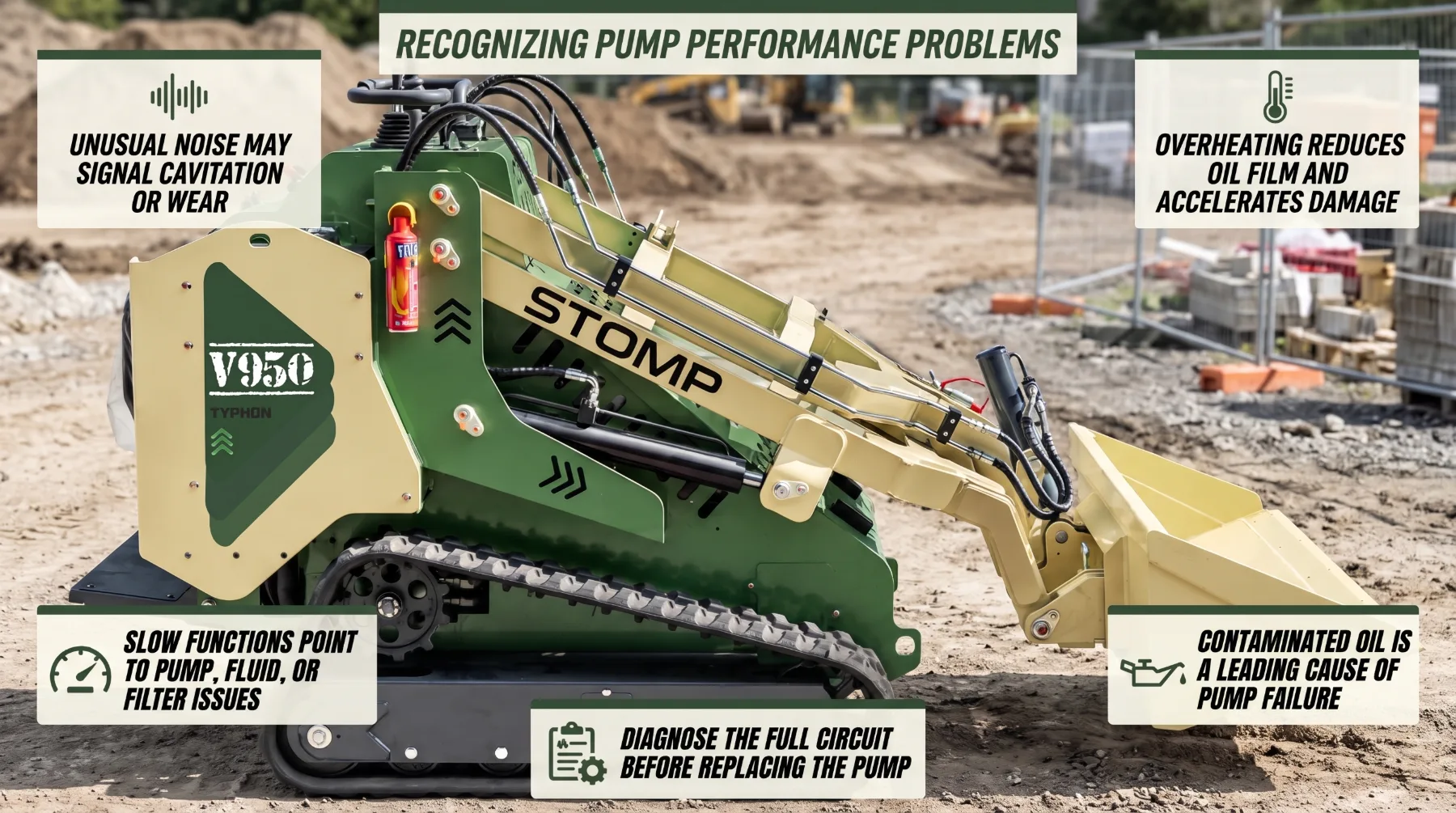
These symptoms may indicate pump wear, but other system problems can produce the same signs. Contaminated oil, whether from dirt, metal particles, or water, is a leading cause of pump wear. Particles score internal surfaces and increase internal leakage, while water reduces lubrication and promotes corrosion. A clogged suction strainer starves the pump inlet and causes cavitation. A blocked return filter in bypass sends unfiltered oil back into the system. Air entering through a loose suction fitting, damaged hose, low oil level, or worn shaft seal causes aeration, producing noise, spongy response, and internal damage. Incorrect fluid viscosity, overheated oil from a clogged cooler or damaged fan, electrical faults, collapsed hose linings, and malfunctioning relief valves can all produce similar symptoms.
Some patterns help narrow the cause. When all functions slow at once, the issue likely points to the pump, oil level, inlet restrictions, or a shared component. When only one function is slow, the cause is more likely that function's valve section, cylinder, or motor. Problems that appear only when hot may indicate increased internal leakage as oil thins, or a cooling issue. Problems only when cold may point to viscosity or inlet restriction. Noise after service often indicates air in the system, low oil level, or incomplete priming.
When problems appear, respond safely. Lower the arms and attachment to the ground, shut down the engine, and relieve hydraulic pressure using the manufacturer's procedure before inspecting. Check the oil level, look for leaks using cardboard rather than your hand, and inspect accessible hoses and fittings. If the pump is making abnormal noise, stop operating the machine immediately. A pump starved of oil or running with heavy aeration can suffer serious damage in a short time.
Key takeaway: Unusual noise, overheating, slow functions, and inconsistent response can signal pump wear, but contaminated oil, blocked filters, air entry, incorrect fluid, and control faults produce similar symptoms. Diagnose the entire hydraulic circuit before replacing the pump.
Pump Speed and Flow
Engine speed changes affect available flow on fixed-displacement pumps. Cutting engine speed in half roughly cuts pump flow in half, which is why attachments often slow when the throttle is reduced and why manufacturers typically specify a required engine speed for hydraulic attachment operation.
Engine RPM alone is not a reliable way to estimate attachment flow. Two loaders with the same engine speed may use pumps of very different displacement. Some pumps turn faster or slower than the engine through gear drives. Variable-displacement controls respond to system demand rather than shaft speed alone. The pump may also supply several circuits at once, so the auxiliary circuit does not always receive the pump's full output. Flow control valves, electronic settings, pump wear, hot oil, and engine loading under heavy demand all further reduce actual delivered flow.
The most reliable reference is always the manufacturer's published auxiliary flow figures at rated engine speed for standard-flow and high-flow circuits. When actual performance is in question, a qualified technician can measure real flow with a hydraulic flow meter under defined conditions.
Key takeaway: Flow depends on both displacement and pump speed, but pump design, drive ratios, control settings, flow sharing, and system condition all affect delivered flow. Always rely on the manufacturer's published auxiliary flow figures rather than estimating from engine RPM alone.
Pressure and Hydraulic Work
Pumps produce flow, not pressure. Pressure develops only when that flow meets resistance. When oil leaves the pump with nowhere to work against, it circulates back to the reservoir at low pressure. Raise a loaded bucket and the weight of the load resists the lift cylinders, so pressure rises until it is high enough to move the load. Push an auger into hard clay or drive a trencher chain through compacted ground, and pressure climbs in the same way.
Resistance in a skid steer's hydraulic system comes from several sources, including the weight of material in the bucket or the resistance of soil against an attachment, friction within seals and motor internals, pressure drops caused by hoses and fittings, and the rapid pressure rise that occurs when a cylinder reaches the end of its stroke.
Pressure has an upper limit set by the system's relief valve. Once pressure reaches that setting, the valve opens and sends oil back to the reservoir, protecting the pump, hoses, cylinders, and motors from overload. When pressure reaches relief, the function stalls or slows, and the bypassed oil converts its energy into heat.
It is important to understand what pressure does and does not tell you. Flow determines speed. More oil reaching a cylinder or motor makes it move faster. Pressure determines force, allowing the cylinder or motor to overcome greater resistance. A loader can have a high relief pressure but limited flow, meaning it lifts heavy loads but slowly. Another loader can deliver generous flow at a lower relief setting, moving quickly but stalling sooner under heavy resistance. Neither figure alone describes the system's full capability. Hydraulic power combines both, and it can never exceed the power the engine supplies to the pump minus losses.
Key takeaway: Pumps create flow, and pressure builds only as that flow meets resistance. High pressure provides force but not speed, and true hydraulic work depends on flow and pressure together within the limits of the engine's available power.
Maintenance and Power Delivery
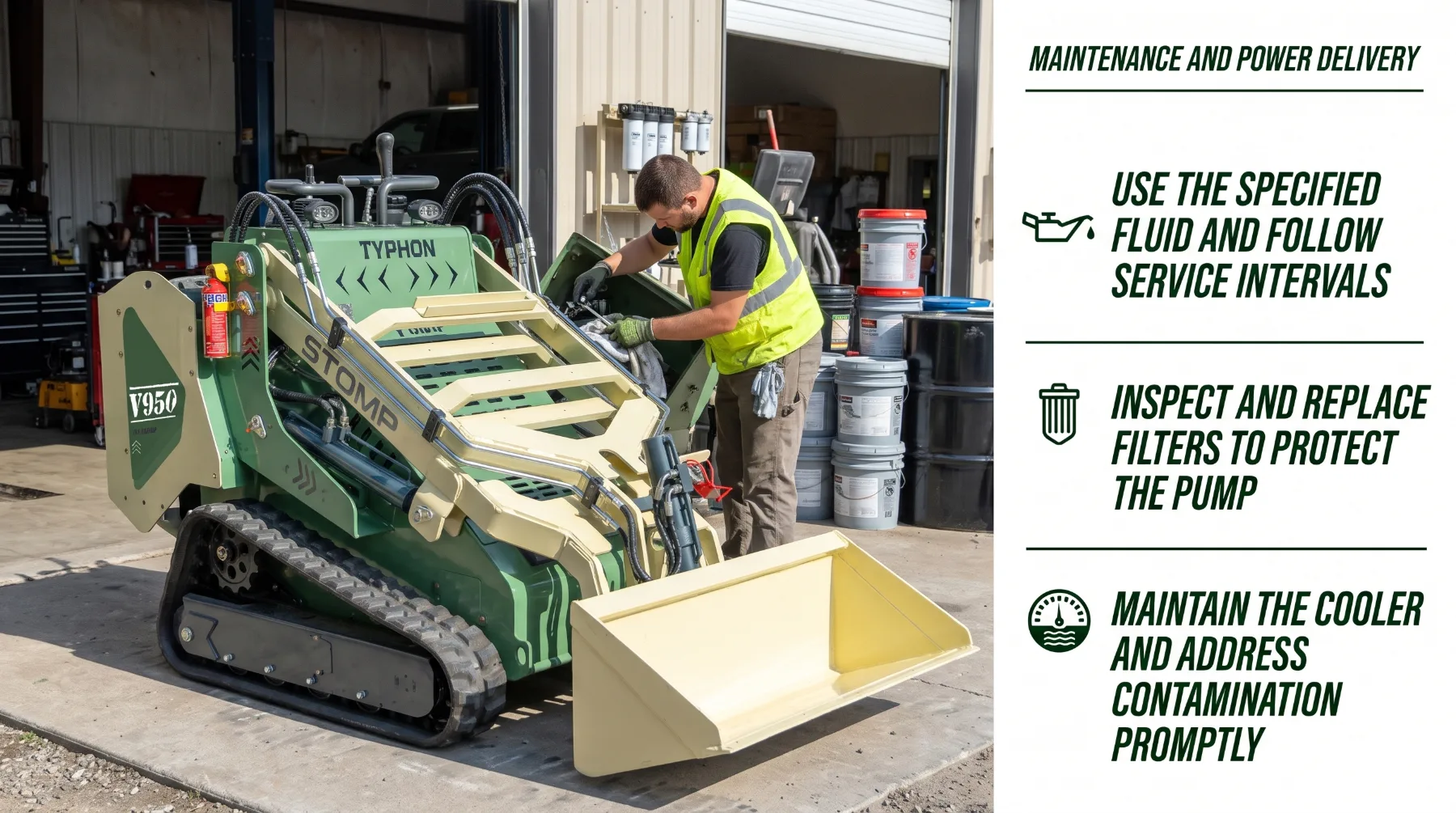
A well-maintained hydraulic system delivers its designed power for thousands of operating hours. A neglected one loses efficiency gradually through rising internal leakage, higher operating temperatures, and slower response, long before any single component fails.
Using the correct hydraulic fluid is the foundation of pump protection. The operator's manual specifies the fluid type, viscosity grade, and performance requirements the system needs. Correct fluid ensures the pump inlet fills properly at startup, maintains a protective film between moving parts, and resists foaming, oxidation, and wear. Do not mix fluids unless the manufacturer confirms compatibility, and match viscosity to the operating climate where the manual provides options.
Service intervals exist for a reason. Change hydraulic oil and filters at the intervals the manufacturer specifies, and shorten those intervals under severe conditions such as heavy auxiliary attachment use, high ambient temperatures, or dusty environments. Oil analysis provides valuable insight into wear metals, contamination, and fluid condition, helping you plan maintenance based on real data rather than assumption.
Filters are the pump's primary defense against contamination. Return filters should be replaced on schedule and sooner if a restriction indicator shows they are clogged. Charge filters protect hydrostatic drive components and must be changed as specified. Suction strainers should be cleaned or replaced per the service procedure, since a restricted strainer can starve the pump. Breather filters keep dust out of the reservoir and should be replaced on schedule. Use only filters that match the manufacturer's specifications for micron rating, flow capacity, and bypass setting.
Hoses and fittings deserve regular inspection. Look for cracks, abrasion, bulges, kinks, and worn outer covers, and check fittings for seepage and loose connections. Pay close attention to suction hoses, since a small leak on the suction side may draw in air rather than leak oil, making it harder to spot. The cooling system also needs consistent attention. Dust, chaff, mud, and debris can pack into cooler fins and restrict airflow, especially during mulching or work in dry conditions. Overheated oil breaks down faster, thins out, and increases internal leakage, all of which reduce power delivery.
Contamination control is equally important. Keep coupler faces clean before connecting attachments, use protective caps, and clean around fill points before adding oil. If oil appears milky, dark, or foamy, or if analysis shows high contamination, identify the source and follow the manufacturer's corrective procedure promptly.
Operating habits also protect the pump. Allow the hydraulic system to warm up in cold weather before applying heavy loads, avoid holding functions against their end stops or at relief pressure for extended periods, run attachments at the engine speed the manufacturer specifies, and keep auxiliary attachments within the circuit's rated flow and pressure limits.
Pressure and flow testing should always be left to qualified personnel. Accurate diagnosis requires calibrated flow meters, pressure gauges rated for system pressure, correct test fittings, and the manufacturer's test procedures. Testing at high pressure with equipment connected carries real risks of hose failure, fluid injection injury, and unexpected machine movement. Never adjust relief valve settings or pump controls in an attempt to increase attachment power. Raising pressure beyond the manufacturer's specification can overload the pump, hoses, cylinders, and motors, increase heat, strain the engine, and create serious safety hazards.
Key takeaway: Protect power delivery by using the specified fluid, following service intervals, maintaining filters, hoses, and the oil cooler, addressing contamination quickly, and relying on qualified personnel with the correct instruments for pressure and flow testing.
Conclusion
Pump displacement helps explain how skid steer loaders generate hydraulic flow, but pressure, speed, engine power, and system design all shape real-world performance. Displacement sets the volume of oil the pump moves with each revolution, and pump speed turns that volume into flow. Published auxiliary flow figures remain the most reliable reference, because pump design, drive ratios, control settings, flow sharing, and system condition all influence what actually reaches an attachment. Pressure builds only as flow meets resistance, providing the force behind every lift and cut, while flow determines how fast that work happens, both operating within the limits of the engine's available power.
The pump arrangement determines how travel, lift, tilt, and auxiliary circuits share that output, which explains much of how a machine behaves during combined movements. When performance changes, accurate diagnosis looks at the full circuit, from oil condition and filters to suction connections, cooling, and controls. Consistent maintenance, correct fluid, and qualified testing preserve the hydraulic power your machine was designed to deliver. When you understand these factors and maintain the system with care, your skid steer provides reliable, productive performance on every job.
FAQs
Does a larger displacement pump always provide more power?
Not necessarily. Power also depends on pressure, pump speed, engine capability, and system efficiency. A larger displacement pump moves more oil per revolution, but hydraulic power reflects both flow and pressure, and it can never exceed the power the engine supplies to the pump. A pump that is too large for the engine may pull engine speed down under load, reducing actual flow. Internal leakage, hot oil, and restrictions in the circuit also reduce the power that reaches cylinders and attachments.
Can pump flow be estimated from engine horsepower alone?
No. Pump displacement, rotational speed, pressure, and hydraulic system design must also be considered. Engine horsepower describes total engine output, much of which goes to travel, cooling, and other loads. Flow depends on how much oil the pump moves per revolution and how fast it turns, adjusted for volumetric efficiency and any flow sharing or control limits. Use the manufacturer's published auxiliary flow figures, and have a qualified technician measure actual flow when performance is in question.
What can cause slow hydraulic functions?
Pump wear, restricted filters, fluid problems, leaks, or control faults may reduce performance. Other common causes include low oil level, air entering the suction side, incorrect fluid viscosity, overheated oil, a clogged oil cooler, collapsed hoses, relief valve problems, and reduced engine speed. Combined movements can also slow individual functions as they share available flow. Lower the attachment, shut down, relieve pressure, and check basic items such as oil level and visible leaks before arranging professional diagnosis.
Should hydraulic pressure be adjusted to improve attachment power?
Only according to the manufacturer's specifications. Unapproved pressure changes can damage components and create safety risks. Raising relief pressure beyond its rated setting can overload the pump, motors, cylinders, and hoses, increase heat, strain the engine, and raise the risk of hose failure and fluid injection injuries. If an attachment lacks power, confirm it matches the circuit's flow and pressure ratings, and have a qualified technician test the system to identify the actual cause.